
Product Page
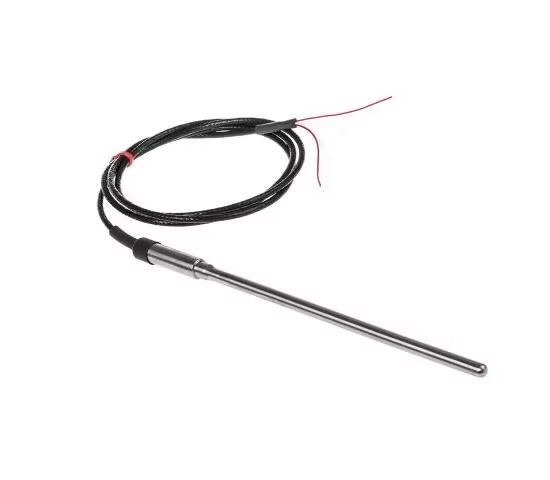
Resistance Sensor PT100
₨0
Need some help?
Contact Us
Product Ships in
2-3-business Days
Payment Methods:
Resistance Sensor PT100 in Pakistan
Here’s a detailed product description, features overview, and usage guide for a Resistance Temperature Detector (RTD) PT100 Sensor that you can use for a website:
Product Name:
PT100 Resistance Temperature Detector (RTD) Sensor
Product Description:
The PT100 RTD sensor is a highly accurate and reliable temperature sensor widely used in industrial and laboratory applications. It measures temperature by correlating the resistance of its platinum element with temperature. The "100" in PT100 denotes that the sensor has a resistance of 100 ohms at 0°C.
Known for its stability, repeatability, and wide temperature range, the PT100 sensor is a preferred choice for precise temperature measurement in processes such as HVAC, chemical processing, food production, and environmental monitoring.
The sensor is designed to withstand harsh industrial conditions, ensuring long-term durability and consistent performance.
Key Features:
-
Temperature Range: Typically -200°C to +850°C (depending on sensor type and construction)
-
Resistance: 100 Ohms at 0°C
-
Accuracy: High accuracy and stability, often Class A or Class B as per IEC 60751 standards
-
Material: Platinum sensing element for excellent linearity and corrosion resistance
-
Wiring Types: 2-wire, 3-wire, or 4-wire configurations for different accuracy levels
-
Housing: Available with protective sheath in stainless steel or other materials for protection against environmental damage
-
Response Time: Fast thermal response depending on sheath and installation
-
Compatibility: Compatible with most temperature transmitters, controllers, and data acquisition systems
-
Wide Application: Suitable for industrial, laboratory, HVAC, automotive, and aerospace temperature measurement
How to Use the PT100 Resistance Sensor:
-
Installation:
-
Mount the PT100 sensor in the area where temperature measurement is needed. For industrial use, insert the sensor into a protective thermowell or housing.
-
Ensure proper orientation and firm placement for accurate readings.
-
-
Wiring:
-
Connect the sensor wires according to your configuration:
-
2-wire: simplest but less accurate (includes lead resistance)
-
3-wire: compensates for lead resistance, common in industrial applications
-
4-wire: offers the highest accuracy by fully compensating lead resistance
-
-
Follow wiring diagrams provided by your controller or transmitter manufacturer.
-
-
Connection to Measurement Device:
-
Attach the sensor leads to a compatible RTD transmitter, temperature controller, or data logger.
-
Configure the device to use a PT100 input sensor type.
-
-
Calibration and Testing:
-
Verify sensor readings against a known temperature source or standard for accuracy.
-
Perform calibration if required by your application to ensure precise temperature measurement.
-
-
Operation:
-
Once installed and configured, the PT100 sensor provides continuous temperature readings by measuring changes in resistance of the platinum element as temperature varies.
-
Applications:
-
Industrial process temperature control
-
HVAC systems
-
Food and beverage industry
-
Laboratory and research environments
-
Automotive engine and exhaust temperature monitoring
-
Environmental and meteorological equipment


