Product Page
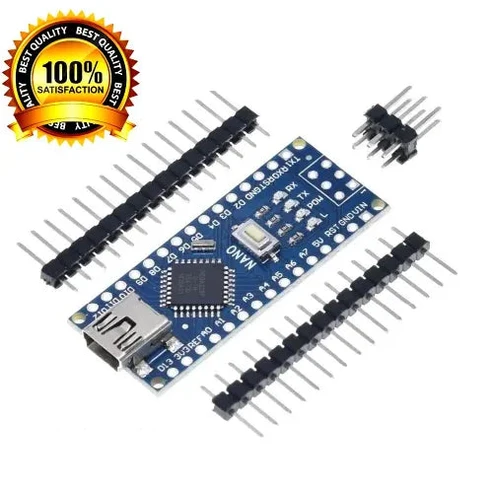
Arduino Nano V3 Development Board
The Arduino Nano V3 is a compact microcontroller development board designed for electronics prototyping, robotics, automation, and embedded systems projects. Its small form factor makes it suitable for applications where a full-size development board may take up too much space. Commonly based on the ATmega328P microcontroller, the Arduino Nano V3 offers digital input/output pins, analog inputs, and USB-based programming for a wide range of DIY electronics applications.
If you are looking for an Arduino Nano V3 in Pakistan, this board is a practical option for students, engineers, hobbyists, and makers who want to build compact electronic circuits and microcontroller-controlled devices.
Key Features of Arduino Nano V3
Compact Board Design: The Nano's small footprint makes it suitable for breadboards, compact prototypes, and embedded projects with limited installation space.
ATmega328P Microcontroller: Common Nano V3 versions use the ATmega328P to execute uploaded programs and control connected components.
Digital Input/Output Pins: The standard ATmega328P-based Nano provides 14 digital I/O pins, including 6 PWM-capable pins for supported output-control applications.
Analog Inputs: It typically provides 8 analog input pins, allowing compatible sensors and variable-voltage signals to be read.
USB Programming: A USB-to-serial interface allows users to upload programs from a computer using the Arduino IDE. The USB interface chip and connector can vary between board versions.
Breadboard Compatibility: Its pin layout makes it convenient for prototyping circuits on compatible solderless breadboards and integrating it into custom electronic assemblies.
Applications of Arduino Nano V3
The Arduino Nano V3 can be used in a wide variety of electronics projects. Common applications include temperature monitoring, light sensors, automatic lighting, digital displays, basic alarms, data logging, and sensor-based control systems.
In robotics, the Nano can serve as a compact controller for line-following robots, obstacle-avoiding vehicles, and small autonomous systems. When paired with suitable motor drivers, sensors, and a compatible power supply, it can process sensor inputs and generate the signals needed to control a robot's movement.
It is also useful for student assignments, science exhibitions, university engineering projects, STEM learning, and DIY automation prototypes. Makers can incorporate the board into compact control panels, measurement devices, and interactive electronic products.
Programming and Compatibility
The Arduino Nano V3 is commonly programmed using the Arduino IDE, where users write sketches in a C/C++-based environment and upload them through the board's USB interface. It supports many compatible sensors, displays, communication modules, and other electronic components.
Most standard ATmega328P-based Nano V3 boards operate at 5V logic. However, verify the specifications of your particular board before connecting 3.3V-only sensors or communication modules. Check the available pinout, memory, USB interface, and power-input requirements to ensure compatibility with your project.
Some Nano-compatible boards use different microcontrollers or USB interface chips, so not every product sold as a Nano V3 will have identical hardware. Confirm the actual board specifications before purchasing or selecting it in the Arduino IDE.
Buy Arduino Nano V3 in Pakistan
Digilog provides electronic components for students, hobbyists, robotics enthusiasts, and DIY developers in Pakistan. The Arduino Nano V3 is a useful development board for building compact prototypes, experimenting with sensors, and learning microcontroller programming.
Whether you are creating a mini robot, developing an automated circuit, or working on a university electronics project, this compact board can help bring your ideas into a working prototype.
Explore the Arduino Nano V3 at Digilog and review the product specifications before ordering. Choose the correct board version for your programming environment, power requirements, and connected components.
Note: Specifications may vary by manufacturer and board revision. Confirm the microcontroller, USB interface, pinout, and included accessories for the exact product.